
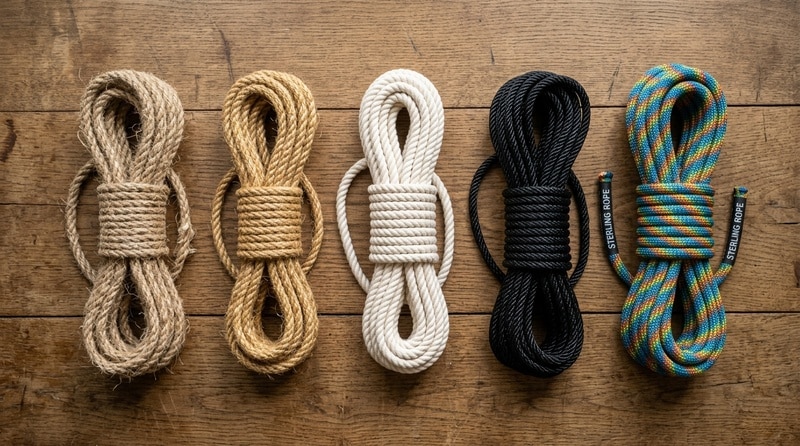
The first step in your shibari journey is choosing the right rope.
In this guide you will find everything you need to know to choose the best rope for you.
If you want to view this content as video lessons, check out the "Choosing Rope" section in our Free Shibari 101 course
https://www.shibariacademy.com/pages/the-ultimate-guide-to-choosing-shibari-rope#cotThe first thing you need to know is that there is no right kind of rope for Shibari.
All rope materials, lengths, and thicknesses have pros and cons and the perfect rope for your session will depend largely on your individual preferences, what you are planning to do, and how sensitive your skin is. (Jump directly to "Quick Comparison of Shibari Rope Materials" section)
That said, if you are new to shibari, start with four 6mm ropes: two shorter ropes around 15 ft and two longer ropes around 30 ft. This gives you enough flexibility for basic ties, floor work, and more advanced patterns as you progress. For material, cotton is often the most accessible beginner option, while hemp or jute gives a more traditional shibari feel.
In this article we will go over the most important characteristics of each type of rope material as well as general considerations regarding rope length and thickness so you can decide what is best for you.
You will learn about:
Rope Basics:
Rope Materials:
Quick Comparison of Shibari Rope Materials
Before we look at rope lengths, thicknesses, and individual materials in more detail, use this quick summary to compare the most common options.
Hemp rope: High grip. Very low stretch. Holds tension well under load. Commonly used by traditional shibari practitioners. Usually needs breaking in and occasional conditioning.
Jute rope: High grip. It has very low stretch, which helps keep tension predictable. Can feel coarser than hemp and may need conditioning, singeing, and light oiling.
POSH: Spun polyester rope. Has medium-high grip and a secure hold with a synthetic feel. It has very low stretch and low elongation under tension. Often used when a natural-fiber look with easier cleaning and lower maintenance is desired.
Cotton rope: Medium-low grip. Soft on the skin, but the fibers can tighten, shift, or become difficult to untie under load. Commonly used by beginners or people with sensitive skin. Easy to wash and usually affordable.
Nylon rope: Low grip. Its smooth surface requires special knots to keep ties in place. Stretch varies by weave. Easy cleaning and bright colors. It is low maintenance and easy to wash, but cut ends usually need heat sealing.
Climbing rope: Not recommended for shibari. It is usually too bulky, stiff, and poorly suited to compact shibari knots. Stretch varies depending on the rope type.
Beginner Rope Kit
Most people are able to perform the majority of Shibari ties using:
- 2 short ropes 15 ft long 6mm thick
- 2 long ropes 30 ft long 6mm thick
This gives you enough rope for simple ties, beginner harnesses, and longer patterns without overwhelming you with too much rope.
As you progress in your journey, you will be adding ropes of different lengths, thicknesses, and materials. That said, a 4-rope kit is a good place to start.
Check out Shibarirope.com for an affordable, DIY Shibari Hemp Rope Kit, with 100ft of rope. Great for beginners and advanced students alike that want to live the experience of treating their own hemp ropes and avoid the steep price of pre-treated hemp rope kits.

Rope Safety
Along with rope, safety shears are a must-have in your rope kit. Keep them close during every shibari session in case you need to cut rope quickly. Shibari can be fun but it is not risk-free. Learning about possible injuries is the best way to protect yourself from them. Knowing about nerve pressure, circulation, communication, and emergency release is part of responsible rope practice.
We recommend you go over our safety guides before you begin tying:
Rope Length
Shibari rope lengths range from 10ft all the way to 30ft or more. During a Shibari session, you will probably use a combination of rope lengths depending on what you are tying.
Remember that you can always extend the rope by attaching multiple lengths, therefore it is better to have multiple shorter ropes than to have a very long rope. Long rope can become problematic because it can get tangled and can get annoying. With long rope, you'll spend most of your session pulling rope through loops and knots.
Here's a more detailed look at different rope lengths:
Shorter Lengths (3-5 Meters, about 10-16 Feet):
-
Usage: Shorter ropes are useful for simpler ties such as wrist cuffs, ankle ties, or partial body harnesses. They are also handy for adding extensions or finishing off complex ties.
- Considerations: While convenient for small areas, these ropes limit the complexity of ties that can be achieved without additional extensions, which can interrupt the flow and aesthetics of the pattern.
7-8 Meters (23-32 Feet):
-
Usage: This length is considered the standard in Shibari because it provides enough rope for most traditional patterns without the need for frequent extensions. It's ideal for full-body ties and complex patterns that require more rope.
-
Considerations: Managing this length of rope requires skill, as it can become cumbersome and prone to tangling if not handled correctly. Practitioners need to be adept at rope management to prevent interruptions during the tying process.
Longer Lengths (10+ Meters, 33+ Feet):
-
Usage: Longer ropes are less common but can be beneficial for very intricate or large-scale ties, or when tying multiple partners with a single continuous length.
- Considerations: Handling such lengths requires significant skill in rope management to avoid tangling and ensure safety. They are typically used by more experienced practitioners who are comfortable managing excess rope during complex patterns.
Rope Thickness
Rope thickness in Shibari ranges from 4mm - 8mm.
Less than 5mm Ropes
-
Usage: Ideal for detailed work, such as decorative ties or ties involving the fingers, toes, or face. Thinner ropes are more flexible and easier to handle, allowing for intricate designs and knots.
-
Considerations: While they offer precision, thinner ropes can also create more pressure points on the body, which might increase the risk of nerve damage or circulation issues if not monitored carefully.
6mm Ropes
-
Usage: This is a commonly used thickness in Shibari as it provides a balance between functionality and comfort. It's versatile enough for both ground ties and suspensions, making it a good all-rounder for beginners and experienced practitioners alike.
-
Considerations: The 6mm rope is generally safe for most types of ties, providing enough surface area to distribute pressure adequately, thereby reducing the risk of cutting off circulation.
7mm - 8mm Ropes
-
Usage: Thicker ropes like these are preferred for suspension and semi-suspension practices because they offer additional support and durability. They are also more comfortable for the person being tied, as they distribute the load more evenly across a larger surface area.
- Considerations: The primary drawback of thicker ropes is their bulk and weight, which can make complex knots more cumbersome and less precise. They also require strong hands and good technique to manipulate effectively.
Hemp

Hemp is the premium rope option and the favored choice among seasoned Shibari practitioners across the globe.
It is made from natural fibers and hence has the following benefits:
- Its rough texture enables you to create knots that are tightened by friction. In other words, the rope will not slide as easily and your knots will hold better.
- Its lack of elasticity ensures the rope will not be deformed under tension and that the tightness of your knots can be controlled with your hands. In other words, the knots will not become impossibly tight under tension.
- Rope width can be really thin, which is great for aesthetically pleasing knots. Typical rope width is 6mm.
With its exceptional strength, comfort, grip, and sustainable nature, hemp remains the preferred choice for the best Shibari rope material.
However, pre-treated hemp rope kits are expensive which is why most beginners opt for more accessible materials for their first rope kit.
That said, if you treat the ropes yourself they can become quite affordable. Learn how to treat your own Shibari hemp ropes at shibarirope.com
Your ropes might eventually become dirty with use. While we do not recommend cleaning your ropes as a routine exercise because they might get deformed, there might be times when it becomes a necessity.
Cleaning your hemp ropes:
- Washing: Place your ropes in a delicates bag to avoid tangling. Then clean using a clear detergent and a delicate or cold-water cycle in your washing machine. If necessary, you can use an extra spin cycle to remove excess water.
- Drying: Hemp rope needs to dry under tension to keep its structure. You will need two sturdy poles that will not collapse under tension. Using a string or twine, tie one end of the rope to the poll and go around the second pole to create a lever. Then pull for about 20 seconds. Let hang to dry until it is around 80% dry (this can take 3 or 4 days), then apply tension once again before letting dry completely.
- Oiling: Cleaning your ropes removes oils that make them soft and more comfortable to use. The final step in this process is to re-apply lost oil. Wait until your ropes are completely dry. Then, add food-grade mineral oil which is hypoallergenic or a mix of jojoba oil, camellia oil, and beeswax, to a cloth. Run the rope through the cloth section by section.
Visit shibarirope.com for an in-depth tutorial on how to clean and maintain your hemp ropes.
Jute

Like hemp, jute is one of the go-to materials in modern Shibari. It is visually almost identical to hemp.
It provides all the benefits afforded by hemp rope with the added perk of being significantly less expensive.
However, this dip in price comes at a high cost.
Unlike hemp, jute fibers are rough and can become quite uncomfortable for the person being tied. Also, jute is a lot less flexible than hemp, making it harder to tie and resulting in bulkier knots.
As a warning, when you search for hemp rope kits on marketplaces such as Amazon, Ebay, or Etsy, vendors usually use jute and hemp interchangeably so it's almost impossible to tell the difference until you use the ropes. As a general rule of thumb, if the ropes seem really cheap, then they're most likely made of jute.
Like hemp rope, cleaning jute rope can be tricky. Follow the cleaning guide for hemp rope to keep your ropes in optimal shape.
Posh / Spun Polyester

Posh is made from synthetic material but visually blends with hemp rope.
Due to Posh being synthetic, it affords a several benefits over natural fiber ropes:
- It's considerably cheaper than hemp.
- They are a lot more durable than natural fibers.
That said, posh is more stiff than hemp, so detailed knots can be more difficult to make and end up looking bulky. Also, it is very difficult to find. Only a few specialty stores have it in stock.
Cotton

Cotton is also a relatively common Shibari rope material, more so amongst beginners due to its low price.
The pros of choosing cotton are:
- It’s cheap. A complete rope bondage kit can get really expensive and if you are just beginning and are not entirely sure if you want to pursue Shibari seriously, this is a great alternative that will allow you to explore Shibari without taking an economic hit.
- It is softer than hemp which means it is more comfortable for the person being tied.
- It is great for beginners because it takes a lot of speed or pressure to cause rope burn.
It takes time to fully master the art of tying and untying and unfortunately, rope burns can happen especially with inexperienced riggers. Using cotton reduces the likelihood of these kinds of accidents.
- It becomes even softer when you wash it.
- It is very easy to dye, so you can color it any way you want.
This is great if you want to customize your rope kit and infuse it with your personality.
- It is also very light, which means that you can carry lots of rope around with ease.
On the down side:
- Unlike hemp, it is elastic which means that it stretches under tension. This makes it difficult to control the tightness of the knots and make these knots difficult to untie. It can get a little frustrating and dangerous so make sure you have your shears close by.
- Cotton does not absorb lubricating oil and when it’s dry, the rope can feel coarse and there is not much you can do about that.
- It can get dirty and fuzzy easily which makes your ropes look a bit gross.
Nylon

Nylon is commonly used in Europe and America.
It is not a material that's traditionally used for Shibari, but it has recently gained popularity for it's bright colors, easy maintenance, and low price.
On the plus side:
- it is cheap, smooth and very flexible.
- It takes a lot of tension and pressure for it to cause rope burn.
- It is very easy to clean and maintain. Just stick them in the washer and let them dry on their own.
That said, because nylon ropes are smoother than ropes made with natural fibers (like hemp, jute, and cotton) they do not hold knots very well and different techniques are needed for knots to stay tied. (We will not be going over these techniques in our tutorials.)
Climbing Rope

Do yourself a favor and don't use them for Shibari.
- Climbing rope is very stiff which can make it difficult to tie detailed knots
- They are quick to cause rope burn which makes them dangerous for the person being tied.
- They feel very rough on the skin which makes ties extremely uncomfortable.
On the plus side, it is sure to hold a lot of tension.
Final Recommendation
For most beginners, a 4-rope kit in 6mm rope is a practical place to start. Cotton is soft and affordable, hemp and jute offer a more traditional shibari feel, and POSH/spun polyester gives you a natural-fiber look with easier maintenance. Nylon can work for specific uses, but its smooth surface requires more attention to knot security. Avoid climbing rope for shibari because it is too bulky, stiff, and poorly suited to body tying.
As you gain experience, you can experiment with different materials, lengths, and thicknesses to find what feels best for your body, your partner, and your style of tying.
Ready to start practicing? Begin with our free Shibari 101 course, or get a beginner rope kit when you are ready to buy your first set.